
The science of staying connected after loss
March 21, 2026

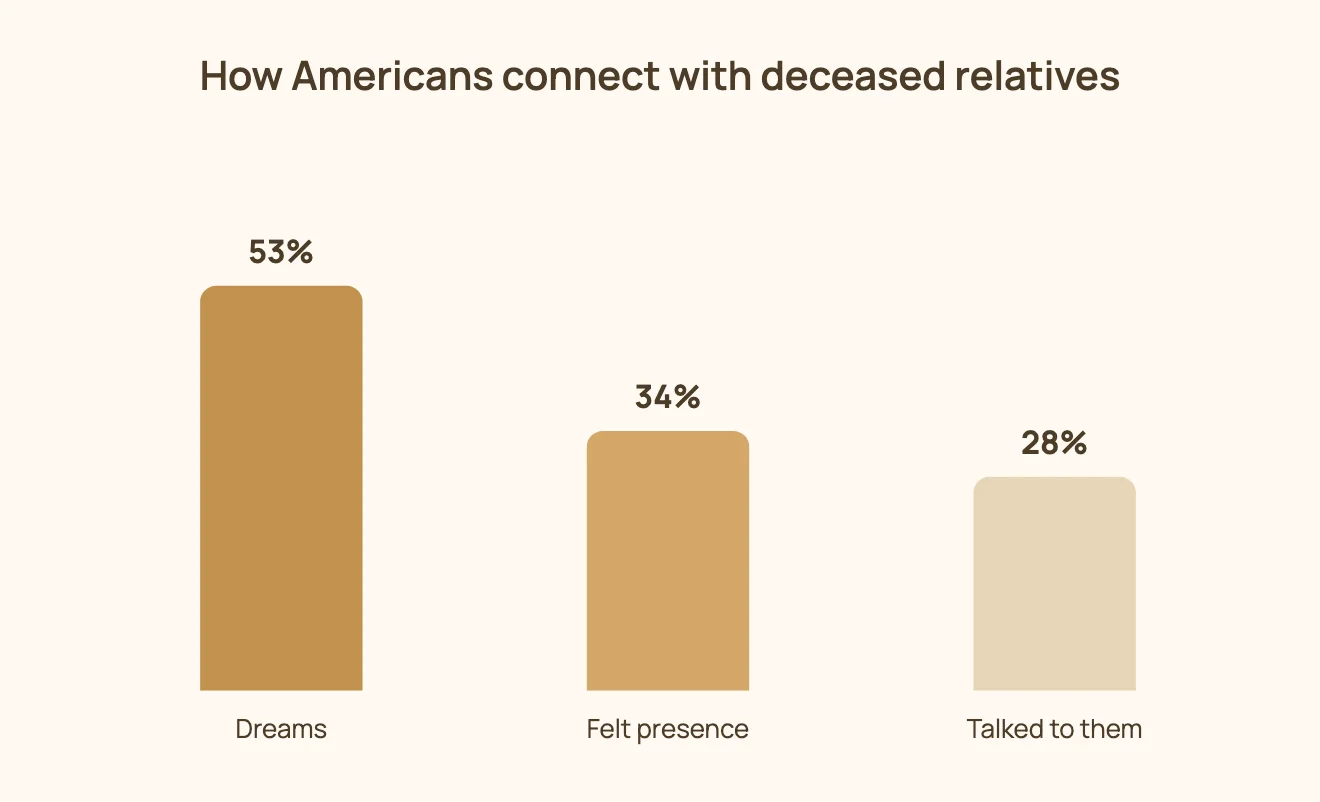
28% of Americans talked to a dead family member in the past year. Just talked to them. About their day, their kids, whatever was on their mind.
That number comes from a 2023 Pew Research survey of over 5,000 people. 34% felt a deceased relative nearby. 53% saw one in a dream.
This is normal behavior. It's one of the most common responses to loss, period.
But the moment technology enters the picture, people get nervous. Suddenly the same thing humans have always done becomes "dangerous" or "exploitative." So let's look at what the research actually says.
Freud got it wrong. It took us 80 years to notice.
In 1917, Freud wrote "Mourning and Melancholia." The argument: healthy grieving means cutting your emotional ties to the person you lost. Move on. Put that energy into new relationships. If you can't, if you keep talking to them or feeling their presence, that's pathology.
This framework ran psychology for almost a century. Therapists repeated it. Friends repeated it. "You need to let go."
They were wrong.
Continuing bonds
In 1996, Dennis Klass, Phyllis Silverman, and Steven Nickman published Continuing Bonds: New Understandings of Grief, and it reframed the entire conversation.
Klass had been studying a self-help group of parents whose children had died. These parents kept their kids in their lives. They talked to them. Felt their presence. Wove them into family conversations. And by every measure Klass could see, they were doing fine.
He later put it simply: "Either all the parents were suffering from pathological grief, or the definition of pathology was wrong."
The definition was wrong.
Thirty years of follow-up research has held. Staying connected to someone you've lost is common, expected, and for most people, healthy. It doesn't block healing. It's part of how people heal.
Therapists have been doing this for decades
Long before anyone built an AI, clinicians were asking grieving people to talk to the dead.
The empty chair technique, from Gestalt therapy, puts an empty chair in front of you and asks you to speak to the person. Say what you didn't get to say. A randomized controlled trial found it reduced depression, anger, and guilt, and the effects held at follow-up.
Letter writing to the deceased is a standard tool in grief psychotherapy. A 2022 review found it helps with self-disclosure, processing unfinished business, and building a coherent story around the loss.
James Honeycutt at LSU spent years documenting how people naturally imagine conversations with people who matter to them, including people who've died. His research identified six functions these imagined dialogues serve: emotional release, self-understanding, compensation for the lost relationship, among others.
The therapeutic world has been telling people to talk to their dead loved ones for a long time. The objection only seems to appear when a computer is involved.
Most of the world already does this
Western psychology's old detachment model was always the outlier.
In Japan, the Obon festival welcomes ancestral spirits home every summer. Families light lanterns at household shrines and talk to the dead. Centuries of practice.
In Mexico, Día de los Muertos (UNESCO Intangible Cultural Heritage since 2008) is built entirely around keeping an active relationship with the deceased. Families build altars, offer food and drink, and invite spirits back.
Across many African cultures, ancestors sit between the living and the divine. Drumming ceremonies invite them to counsel the living. Libation rituals ask for guidance.
Billions of people maintain dialogue with people who've died. If anything, the idea that you should stop talking to them is the strange one.
What the AI grief research found
The best empirical study on this so far was published at CHI 2023, the main academic conference for human-computer interaction. Anna Xygkou, Robert Neimeyer, and five other researchers interviewed people who'd used chatbots as part of their grief process.
People called it "quite therapeutic and sometimes profound." They rated AI grief support higher than support from close friends, mostly because they didn't feel like a burden and weren't worried about being judged. Users became "more capable of conducting normal socializing" after using the chatbot. The chatbot supplemented human connection, people kept talking to friends and family too.
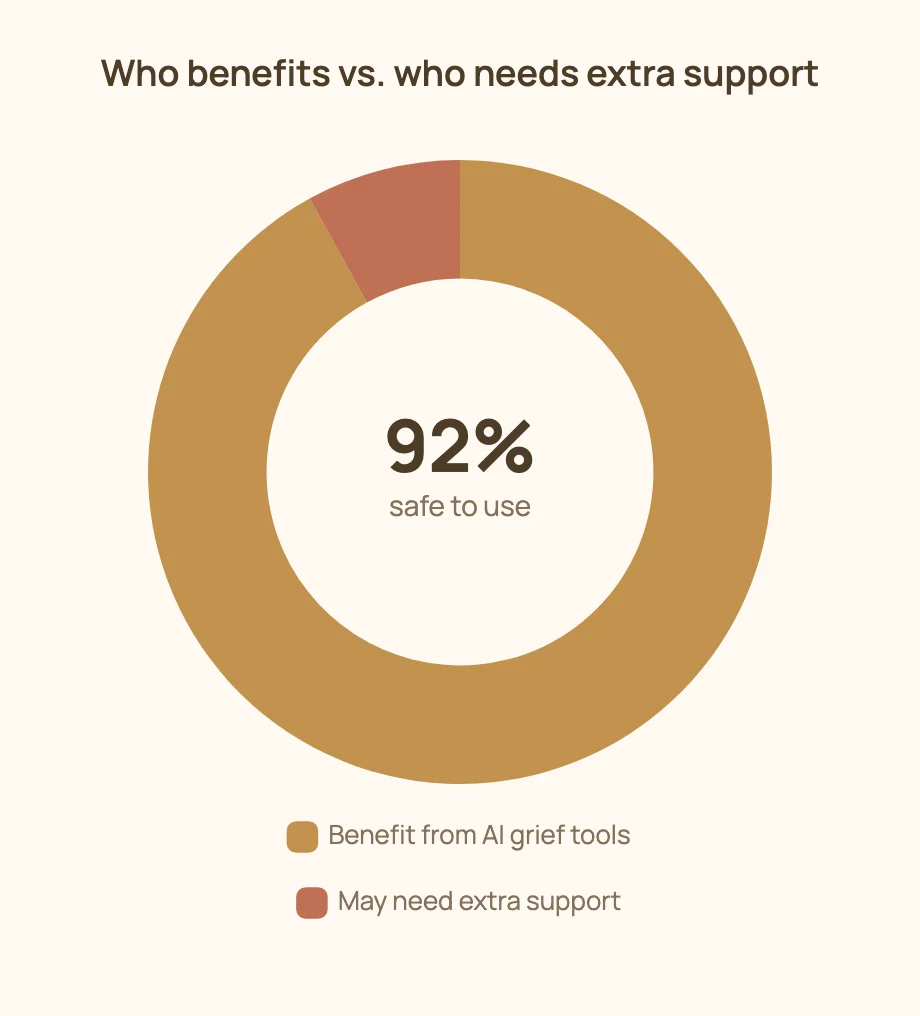
Neimeyer, who has published over 500 papers on grief, calls AI grief tools "an ineluctable part of the emerging technological and cultural landscape." He notes that roughly 7-10% of bereaved people with anxious attachment styles might struggle with any tool that maintains the connection, AI or otherwise. That means over 90% of people are fine. The rest benefit from support and guardrails.
There are a thousand ways to grieve
Margaret Stroebe and Henk Schut's Dual Process Model, which is now the standard framework in grief research, describes healthy grieving as oscillation. You swing between sitting with the loss and getting on with life. Back and forth. There's no straight line and no checklist.
The APA says the same thing: "Grief is not a linear process with predictable stages that you can work through."
People visit graves. Look at photos. Re-read old texts. Wear someone's sweater. Cook their recipe. Write them letters.
Talking to an AI that carries their voice is one more way to do that. An option that didn't exist ten years ago.
On the "exploitation" question
People have used every technology available to stay close to the people they've lost. Gravestones. Photographs. Voice recordings. Home videos. No one calls it exploitation when someone watches old footage of their mother every Christmas, or plays a voicemail they saved just to hear someone's voice again.
Most people building digital memorial tools started because they lost someone. That's where this comes from. A gap that wouldn't close.
Where we stand
We think about this a lot. We build a product that touches people at one of the worst moments of their lives, and that comes with responsibility.
We don't want people to become dependent on talking to an AI version of someone they lost. We don't want to exploit the fact that grief makes people vulnerable. We want to help.
That means being transparent that this is AI. It means designing the experience so people can step back whenever they feel ready. It means adult-only access and consent from everyone involved. Cambridge researchers Hollanek and Nowaczyk-Basinska published a formal ethical framework for this in 2024, and we follow it.
But the deeper principle is simpler: grief has a thousand forms, and people deserve to choose their own. We're here to offer one more option, and to make sure it's a safe one.
Where this leaves us
Talking to someone you've lost isn't dangerous. 28% of Americans already do it without any technology. Therapists have prescribed it for decades. Entire cultures are built around it. Thirty years of grief research supports it. The best study of AI grief tools found people came out more connected, not less.
If there's a danger here, it's in telling someone who's grieving that they're doing it wrong.